The product

A Windows application that shows the real state of your protection.

ScreenShield21 brings system state, protection mode, access methods, paired devices, and recovery paths together in a single local application.

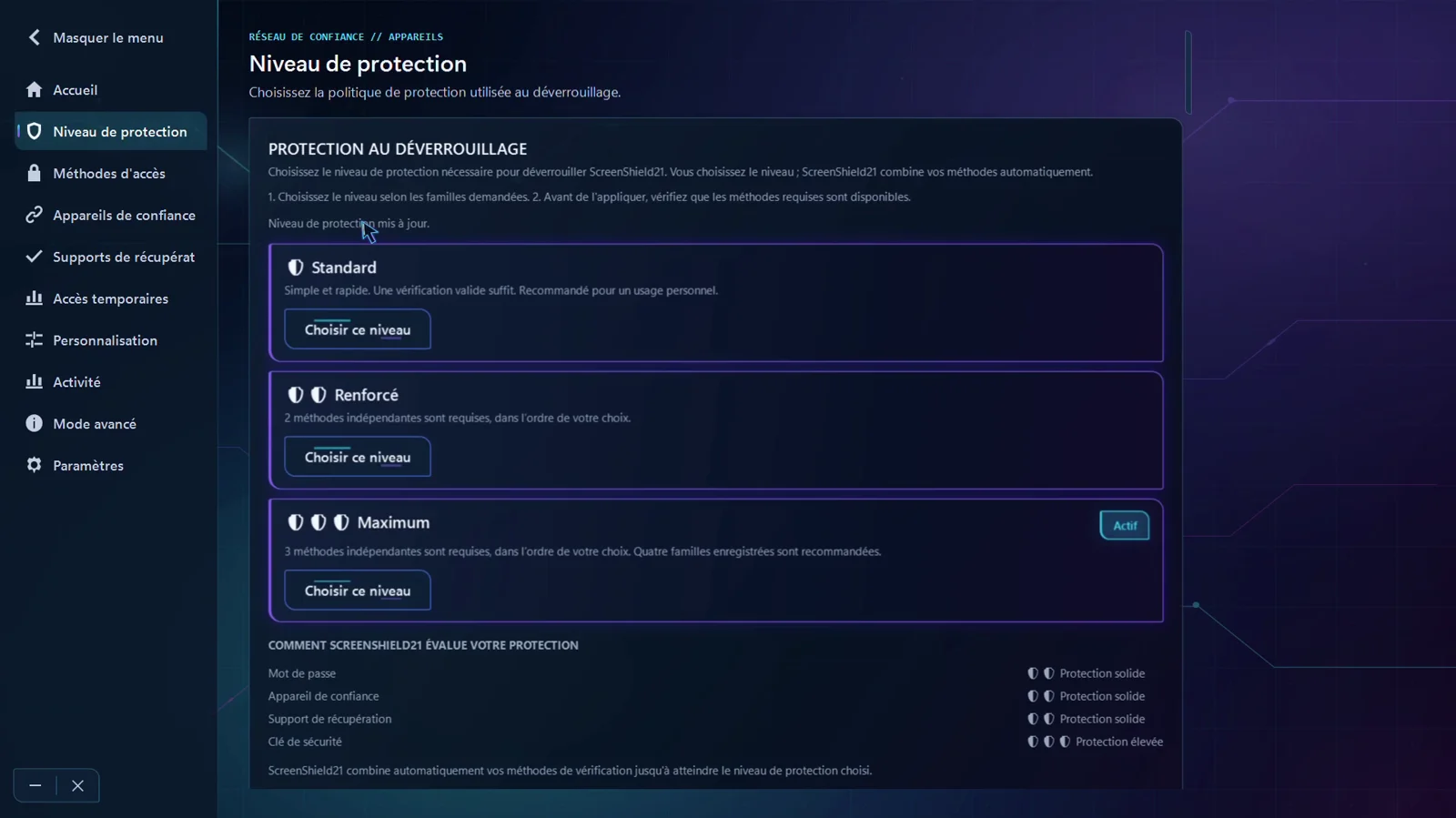
ScreenShield21 Protection level page with the Standard, Enhanced, and Maximum levels and the method evaluation table

See before you act

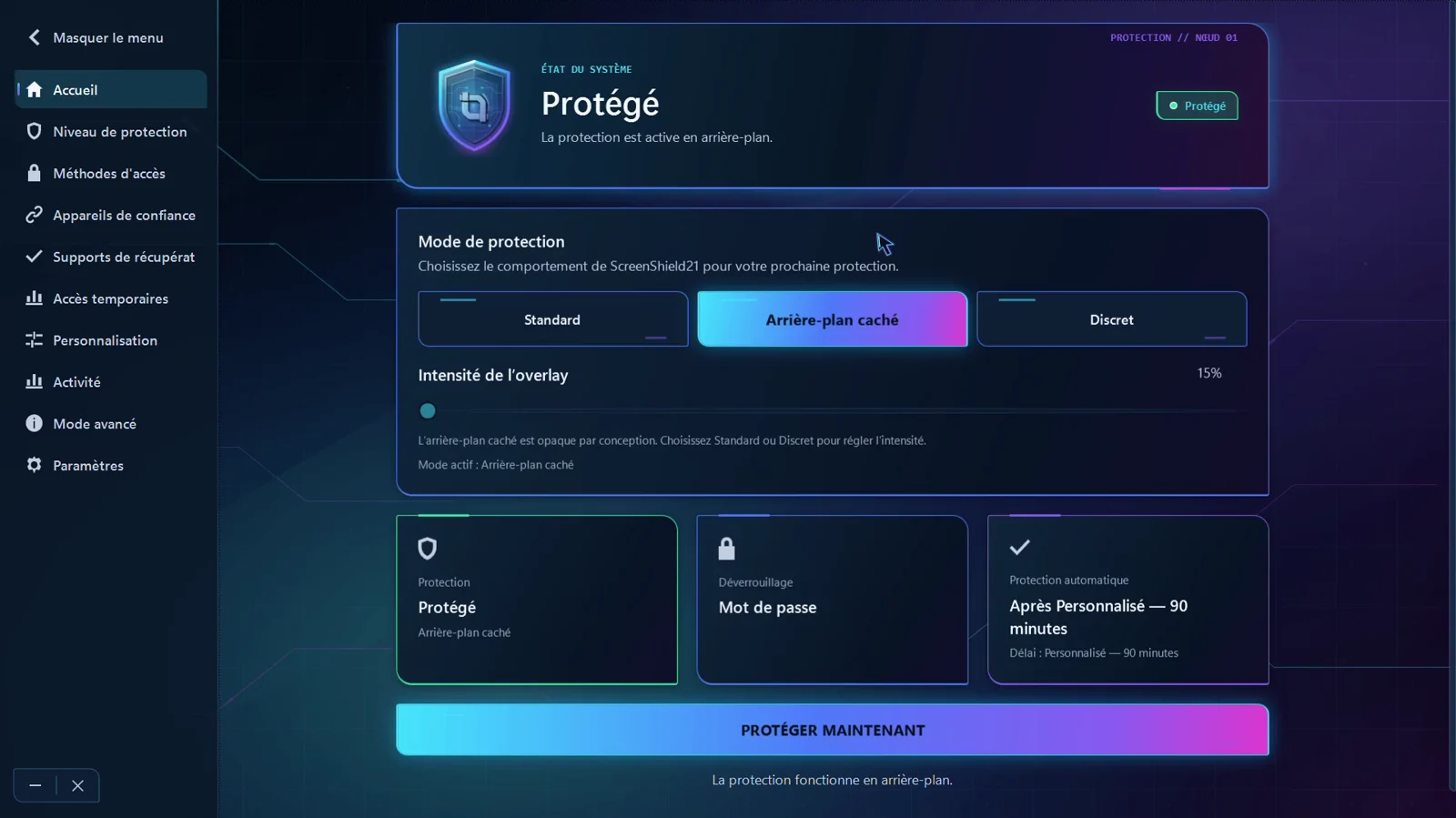
Home puts the protection posture first: what is active, how you will unlock, and how long before protection arms itself.

ScreenShield21 home screen with the Protected state, the mode selector, and the Protection, Unlock, and Automatic protection cards
ScreenShield21 RC1 home screen with Hidden background mode active.
  • A state readable in one sentence, not a noisy dashboard.
  • The protection mode is changed before the next protection starts.
  • Automatic protection arms after an adjustable delay from 30 seconds to 1,440 minutes.
  • A keyboard shortcut you choose protects the screen instantly.

The mode: what appears while protected

Three behaviours, chosen according to where you work.

Mode 01

Standard

Protection veil visible, password field shown. Intensity adjustable from 15 to 70 per cent.

Screen still visible beneath the veil

Mode 02

Hidden background

Screen masked, opaque by design. Intensity adjustment is deliberately disabled in this mode.

Content not readable

Mode 03

Discreet

Password field entirely hidden on the lock screen, revealed by your shortcut.

Keyboard, mouse, and protection stay active

The level: how much proof to unlock

You configure the level from the registered independent families. At unlock, ScreenShield21 evaluates their availability and validates the required proofs.

1

Standard

One valid verification is enough. Recommended for personal use.

1 method

2

Enhanced

Two independent methods are required, in any order you choose.

2 methods

3

Maximum

Three independent methods are required. Four registered families are recommended.

3 methods

Mode and level are two separate settings: the mode decides what is displayed, the level decides what must be proven.

Four families of access methods

Each row is a distinct family. A registered family stays configured even when it is temporarily absent.
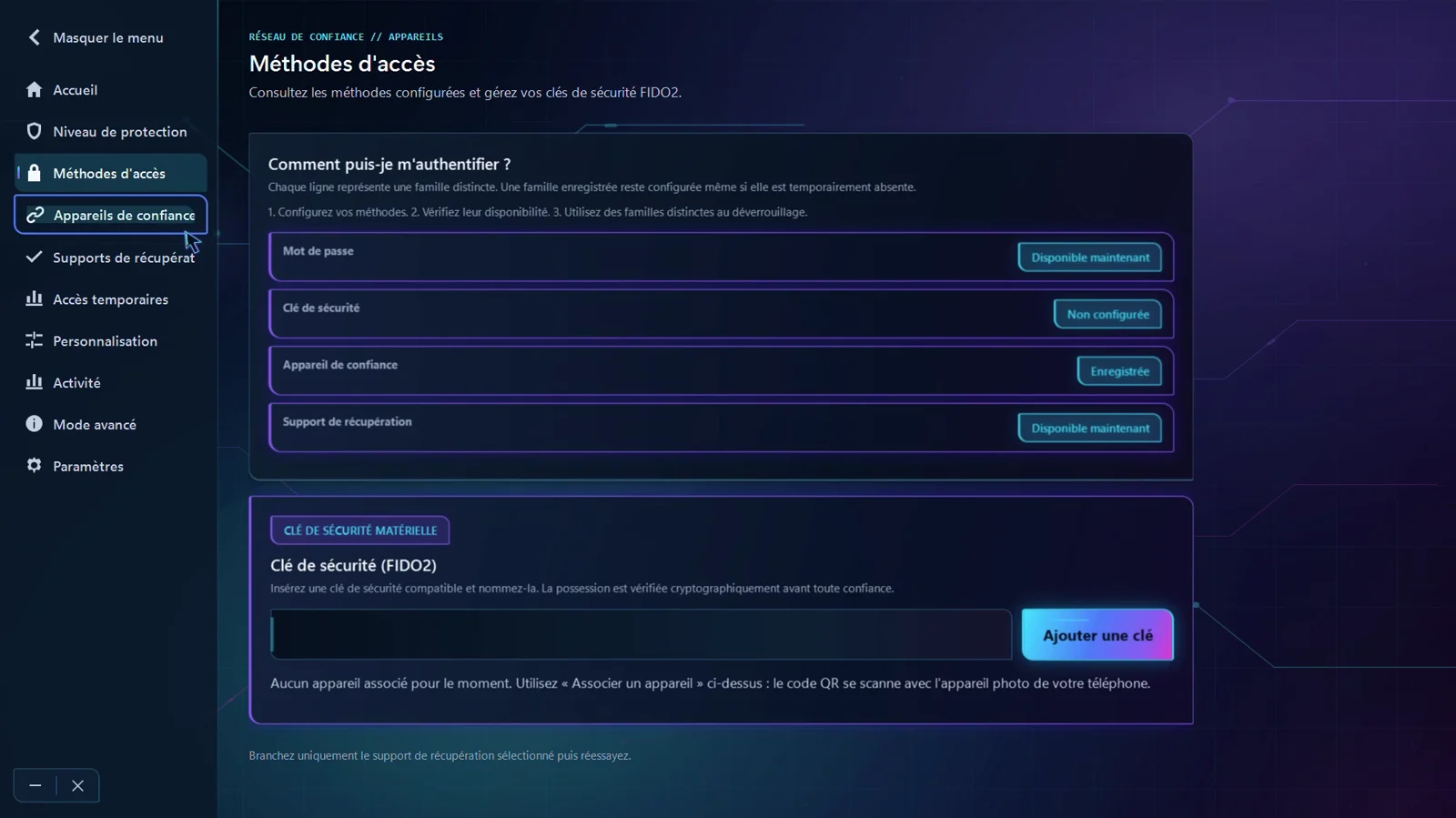
ScreenShield21 Access methods page listing Password, Security key, Trusted device, and Recovery media with their availability
ScreenShield21 RC1 Access methods page, with each family's real availability.
  • Password — verified locally, mandatory fallback method.
  • FIDO2 security key — possession verified cryptographically before any trust.
  • Trusted device — a paired phone, with its own permissions.
  • Recovery media — persistent registration, detected presence, and explicit use.

Discreet mode confirms before it activates

Hiding the password field is useful, but dangerous if you forget how to bring it back. The application refuses to enable the mode until you have reproduced the shortcut yourself.
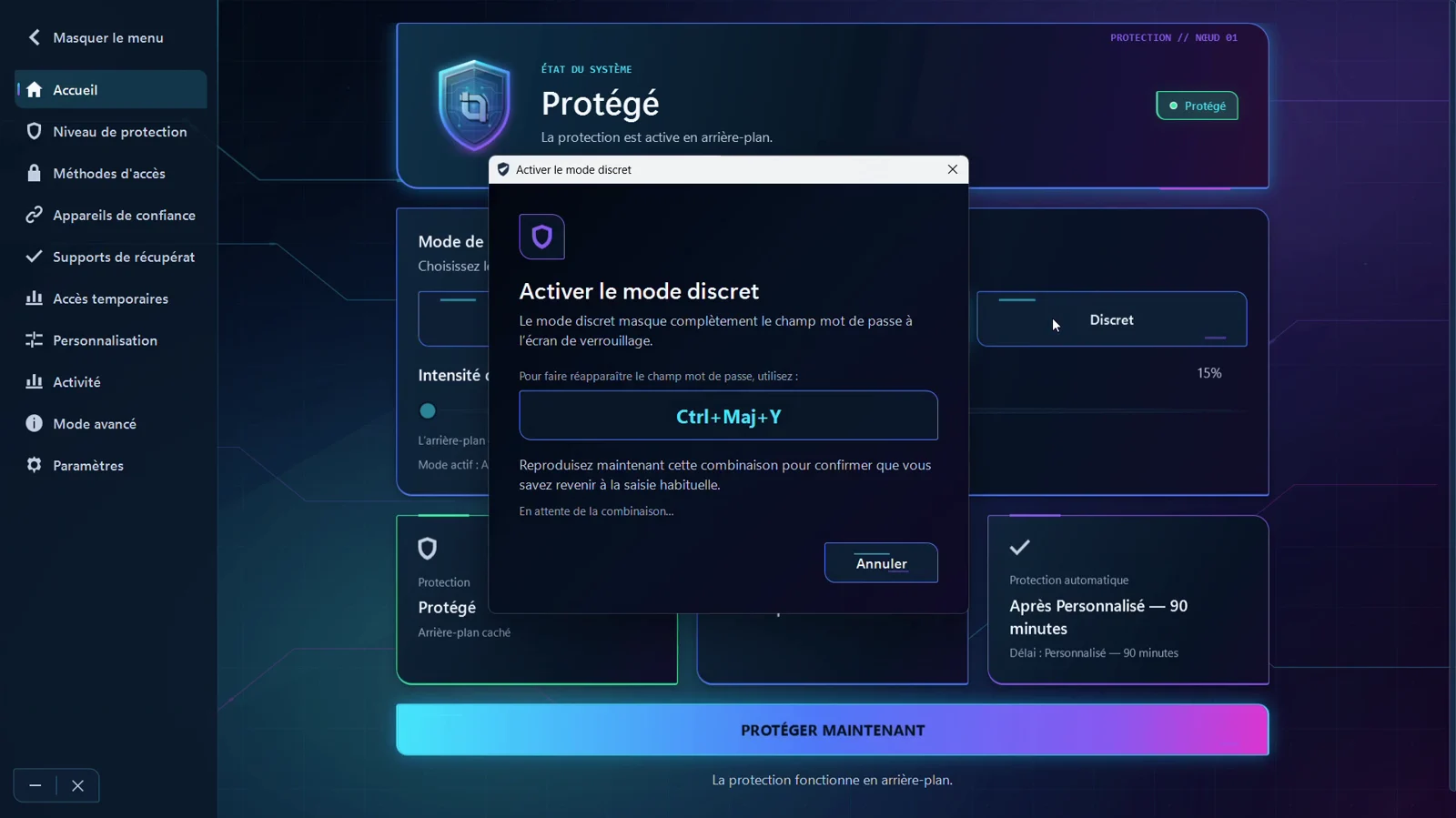
Enable discreet mode dialog showing the Ctrl+Shift+Y shortcut and asking the user to reproduce it to confirm
Discreet mode activation confirmation in ScreenShield21 RC1.
  • The reveal shortcut is shown in plain sight before activation.
  • You must reproduce it to prove you know how to return to normal input.
  • An incorrect combination leaves the mode disabled.
  • The password stays verifiable even while the field is hidden.

Settings that actually exist

Automatic protection
Adjustable delay, permitted values from 0.5 to 1,440 minutes.
Protection shortcut
Configurable combination to protect the screen instantly.
Overlay intensity
From 15 to 70 per cent, in Standard or Discreet mode.
Visual ambience
Five levels, from Disabled to Ultra, plus a reduced-motion option.
Interface sounds
Short protection and unlock signals, removable, with adjustable volume.
Interface language
French or English, applied across the interface at next start.
Start with Windows
Option to make protection available as soon as you sign in.
Activity and diagnostics
Local log and advanced mode, with no transmission outside.

What ScreenShield21 is not

The scope is deliberately narrow, and written here to avoid any ambiguity.

Not an antivirus

No file scanning, no malware detection.

Not a VPN

No encryption of your browsing or general network traffic.

Not enterprise identity management

No directory, no federation, no fleet administration.

Not absolute protection

An adversary who already holds administrator privileges, or prolonged physical access, is outside the scope.